
Mr. Speaker, I was unable to vote during the vote series today. Had I been able to vote, I would have voted: NAY on roll call No. 79, ordering the previous question on H. Res. 1095; NO on roll call No. 80, Passage of H. Res. 1095; YEA on roll call No. 81, passage of S. 723; YEA on roll call No. 82, passage of H.R. 6472; and YEA on roll call No. 83, Motion to Refer H. Res. 1100. PERSONAL EXPLANATION
Live from the 119th Congress
Education
By Legisletter Editors·Published Apr 23, 2026·Updated 6 days ago
Federal education policy is moving on K-12 funding, higher-education access, student mental health, and teacher pay this Congress. Fifteen education bills cover the full spectrum — IDEA full funding, Safe Schools, American Teacher Act, Rebuild America's Schools, Higher Education Act amendments, student mental health access, and targeted loan forgiveness. Track every one, and mobilize constituent pressure.
The state of play
Three fault lines shape education policy. First, K-12 funding and safety — the IDEA Full Funding Act (155 cosponsors) would for the first time meet the 40% federal share promise for special-education funding, while the Safe Schools Improvement Act (160) and Rebuild America's Schools Act (96) address bullying, discrimination, and school facility needs. Second, higher education and campus policy — the Tyler Clementi Higher Education Anti-Harassment Act (103), Freedom of Association in Higher Education Act, and targeted Higher Education Act amendments reshape what colleges owe students and how they govern themselves. Third, student and teacher supports — the American Teacher Act (97), REDI Act, Mental Health Access for Students, Trauma-Informed Education Practices, Fulbright Teacher's Loan Forgiveness, and Territorial Student Access work on different pieces of teacher retention and student well-being.
The through-line: most federal education bills in this Congress expand funding or expand protections, which explains the lopsided stance split toward guardrails. Federal education policy fights are typically about how much to fund, not whether to fund. The cultural-policy battles around curriculum, DEI, and vouchers mostly play out in state legislatures, not federal bills.
Featured speech
Rep. GT Thompson on the IDEA Full Funding Act
Thompson, a former special-education professional, is one of the most consistent Republican voices for full IDEA funding. His floor remarks spotlight the long-broken 40% federal-share promise — currently sitting near 14%. Paired with current lead sponsor Rep. Jared Huffman (D-CA), Thompson's advocacy signals the bipartisan floor the bill's 155 cosponsors are built on.
Take action
Send a letter to your lawmakers about education
Congress is actively debating these bills. Tell your lawmakers where you stand — we'll draft the letter for you.
Start your advocacy campaignThe bills
What Congress is working on
Active in Congress1 bill
- H.R. 2555Freedom of Association in Higher Education Act of 202643 cosponsors·Last action Aug 27, 2026+41 more


In Committee12 bills
- H.R. 1810Safe Schools Improvement Act218 cosponsors·Last action Mar 3, 2025+213 more


- H.R. 2598IDEA Full Funding Act175 cosponsors·Last action Apr 2, 2025+170 more


- H.R. 5486Tyler Clementi Higher Education Anti-Harassment Act of 2025172 cosponsors·Last action Sep 18, 2025+167 more


- H.R. 2021American Teacher Act102 cosponsors·Last action Mar 10, 2025+97 more


- H.R. 7340Rebuild America’s Schools Act of 202697 cosponsors·Last action Feb 4, 2026+92 more


- H.R. 2028REDI Act133 cosponsors·Last action Mar 11, 2025+128 more


- H.R. 3624Improving Mental Health Access for Students Act43 cosponsors·Last action May 29, 2025+38 more


- H.R. 7497Supporting Trauma-Informed Education Practices Act of 202620 cosponsors·Last action Feb 11, 2026+15 more


- H.R. 2664To amend the Higher Education Act of 1965 to provide for additional uses of funds for grants to strengthen historically Black colleges and universities, and for other purposes.22 cosponsors·Last action Apr 7, 2025+17 more


- H.R. 4973Fulbright Teacher’s Loan Forgiveness Act5 cosponsors·Last action Aug 15, 2025


- H.R. 6472Territorial Student Access to Higher Education Act5 cosponsors·Last action Mar 9, 2026


- S. 3063LIFE with AI Act·Last action Oct 28, 2025
Recently Introduced2 bills
- H.R. 6392Home School Graduation Recognition Act9 cosponsors·Last action Mar 9, 2026+4 more


- S. 1070National STEM Week Act1 cosponsor·Last action Mar 3, 2026

On the Record
What Congress Is Saying
Mr. Speaker, as chairman of the Committee on Homeland Security, I rise today in support of the rule providing for consideration of H.R. 7744. As America faces heightened threats on U.S. soil and abroad, DHS is in the midst of its second major shutdown in 6 months because of Democrats' political games. This lapse in appropriations means a disruption in our Nation's disaster preparedness, transportation security, and critical infrastructure resilience when we need it most. As a lifelong New Yorker, I find it outrageous that DHS continues to be undermined by Washington's dysfunction.
 Andrew Garbarino(R–NY)·on Territorial Student Access to Higher Education Act·
Mr. Speaker, I rise in support of H.R. 6392, the Home School Graduation Recognition Act. The bill reinstates and clarifies present law to make clear that homeschooled students are eligible for Federal student aid so that they can pursue higher education. Under the Higher Education Act, students who complete a home school program recognized under their State's law qualify for title IV aid, including Pell grants and Federal student loans. Each State sets its own requirements for the education of homeschooled students.

Show 1 more comment
Mr. Speaker, I rise today in support of H.R. 6472, which would amend the Higher Education Act of 1965 to provide for in-State tuition rates for certain residents of Guam, the Commonwealth of Northern Mariana Islands, the American Samoa, and the United States Virgin Islands. I support this initiative in principle because we cannot ignore the needs of these States. However, we also should not ignore that States and public colleges set their own tuition rates based on State budgets and priorities.
Editorial
Bills at a glance
Original illustrated briefings for the most-tracked bills. Tap a card to read the full analysis.
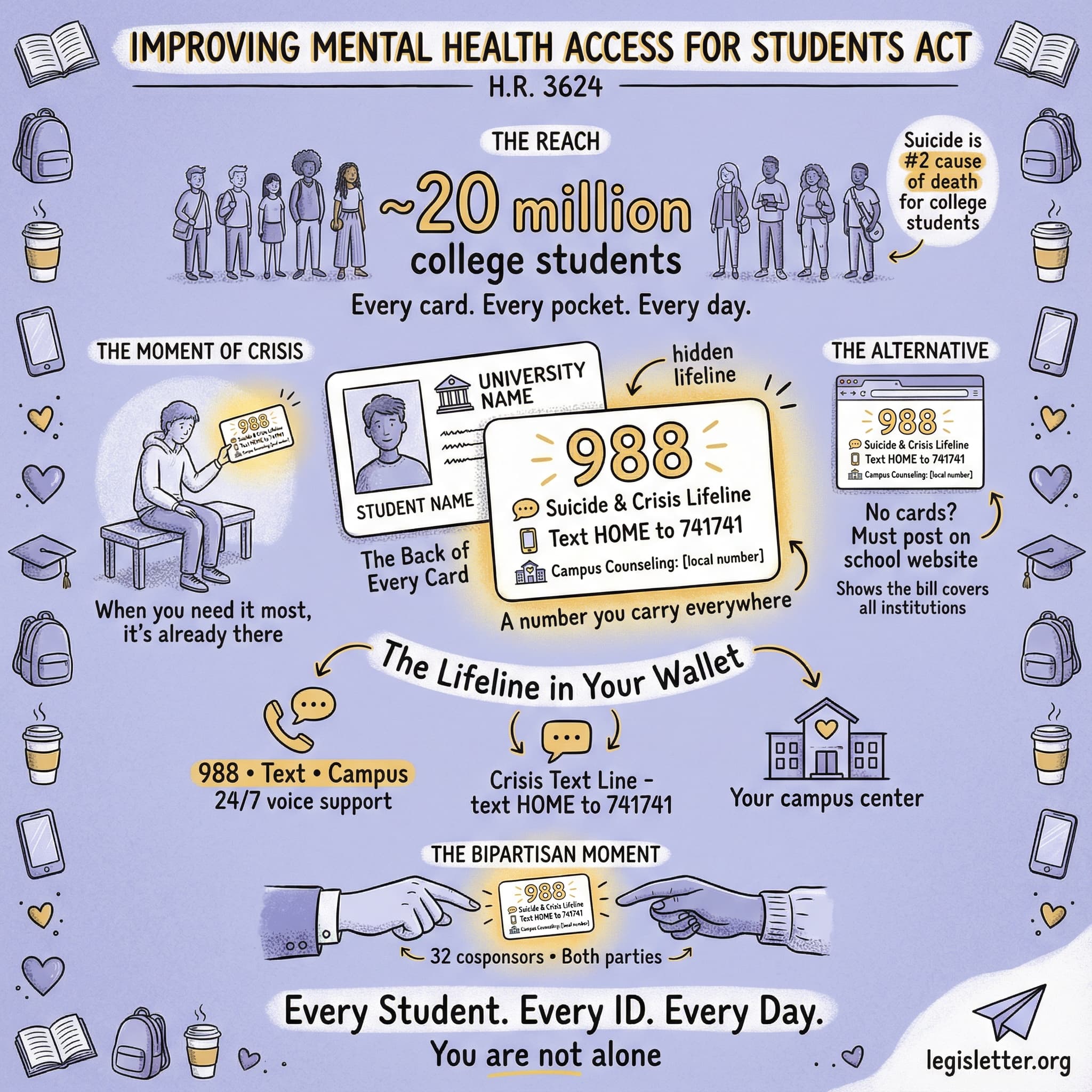
Where Congress stands
How members have signed on
Ranked by bill-level activity — sponsor or cosponsor of bills that expand federal funding and student protections (IDEA, Safe Schools, Tyler Clementi, American Teacher Act, Rebuild Schools) vs. those that expand parental or institutional choice and flexibility (Home School Graduation Recognition, Freedom of Association in Higher Education).
For institutional flexibility
· 12 members


For expanded student protections
· 12 members


Activity weights: sponsor = 10 points, cosponsor = 3 points. A legislator appears in the cluster where their score is highest. Number next to each name is how many bills in that camp they're on.
Follow the money
Who's lobbying these bills
Lobbying on education policy splits four ways: K-12 teachers' unions and education associations; higher-education institutions and their associations; for-profit, religious, and private-school advocacy; and student-advocacy and civil-rights organizations. Each camp files on most major bills.
Colleges, universities, and higher-ed associations
· Preserving institutional flexibilityThe American Council on Education (ACE), Association of Public and Land-grant Universities (APLU), AAU, NASPA, American Association of Community Colleges (AACC), and individual university filers (Harvard, Stanford, Michigan, Berkeley, etc.) file on accreditation, Title IV, federal student aid, anti-harassment rules, and Title IX. They often align with teachers' unions on funding but diverge on compliance and governance.
1 filer · spend bundled into broader disclosures
- Filedmax quarterAMERICAN COUNCIL ON EDUCATION
Student-advocacy and civil-rights organizations
· Supporting student protections and equityThe Education Trust, Leadership Conference on Civil and Human Rights, National Center for Learning Disabilities (NCLD), Trevor Project, GLSEN, Disability Rights Education and Defense Fund (DREDF), and National Student Legal Defense Network file on IDEA, anti-harassment, LGBTQ protections, special education, and student loan forgiveness. Often partner with teachers' union camp but file distinctly on protections.
1 filer · spend bundled into broader disclosures
- Filedmax quarterTHE EDUCATION TRUST
Source: Senate Lobbying Disclosure Act filings (lda.gov), 10 unique filers across these 15 bills. Dollar amounts are the highest quarterly spend reported on any filing that named one of these bills — not a total.
Education Alerts
Get notified when education moves in Congress
New bills, floor votes, cosponsor shifts, regulatory actions — straight to your inbox.
Education alerts + Legisletter's monthly briefing. Unsubscribe anytime.
Written by
Legisletter Editors
Legisletter is a grassroots advocacy platform tracking federal policy — and the impact it lands on everyday Americans.
Data sources: congress.gov · govinfo.gov · lda.gov · sec.gov