
Mr. Speaker, the Rules Committee report (H. Rept. 119-199) to accompany House Resolution 580 should have included in its waivers of all points of order against consideration of H.R. 3633 and S. 1582 a disclosure of the following violation: Section 303 of the Congressional Budget Act which prohibits consideration of legislation providing new budget authority, a change in revenues, or a change in the public debt limit, for a fiscal year until the budget resolution for that year has been agreed to.
Live from the 119th Congress
Crypto Regulation
By Legisletter Editors·Published Apr 20, 2026·Updated 6 days ago
Two crypto bills signed into law, three more on the Senate calendar, and a 135-cosponsor push to block a central bank digital currency. Stay ahead of regulation change — and mobilize constituent pressure.
The state of play
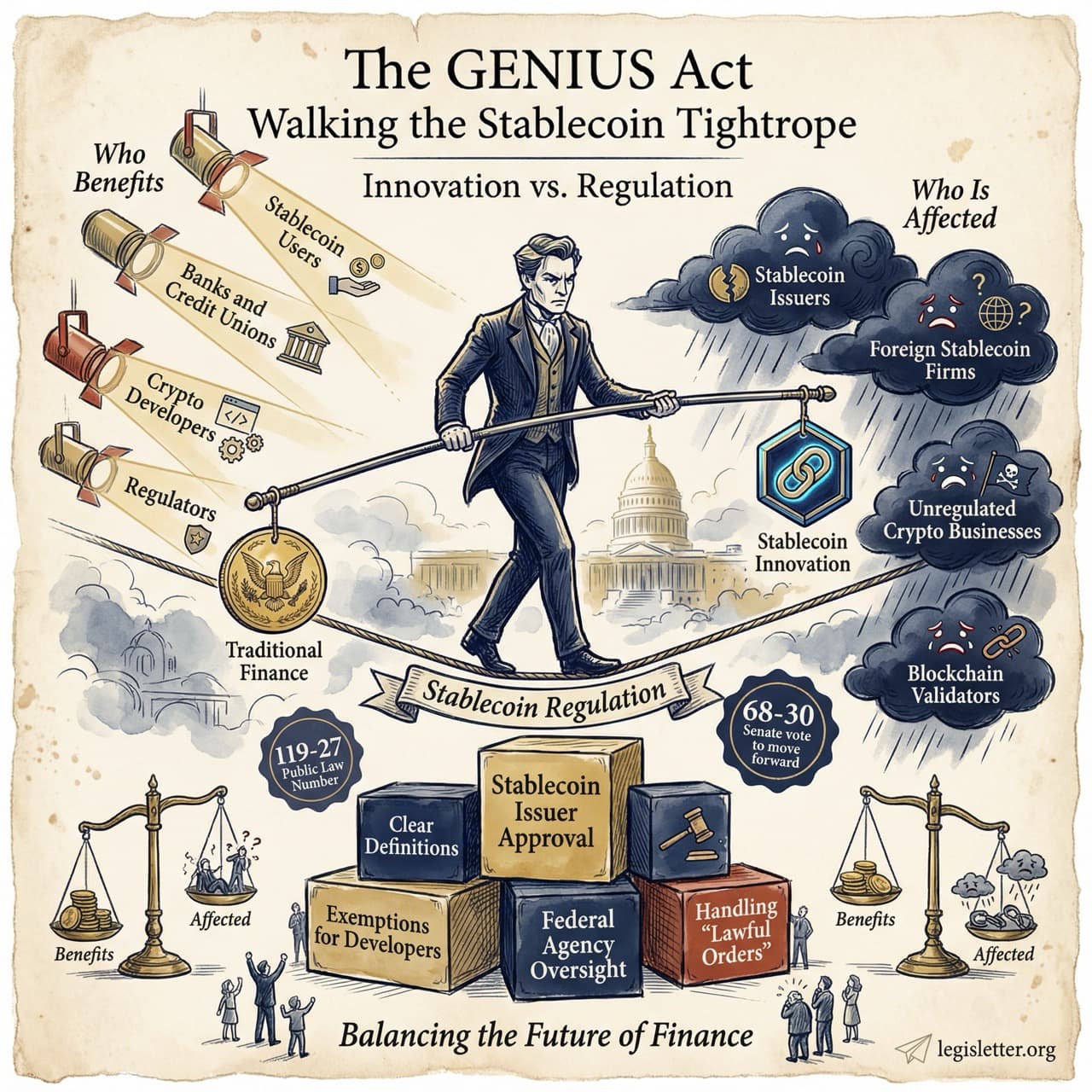
Cryptocurrency regulation moved from Capitol Hill sideshow to front-burner policy this Congress. Two major bills have already been signed into law — the GENIUS Act establishing a federal framework for stablecoin issuers, and H.J. Res. 25 overturning the Trump administration's IRS rule on DeFi broker reporting.
The CLARITY Act, defining which digital assets fall under SEC versus CFTC jurisdiction, passed the House and now sits in the Senate Banking Committee. A bipartisan push to block central bank digital currencies drew 135 House cosponsors for the Anti-CBDC Surveillance State Act. Senate Democrats have countered with anti-corruption and consumer-protection bills aimed at crypto's political entanglements and retail-investor risks. The floor speeches show a Congress taking crypto seriously — as a financial innovation, a national security question, and a political fault line. On April 22, 2026, Tron founder Justin Sun sued Trump-backed World Liberty Financial, alleging it froze roughly $540 million of his WLFI tokens. The suit puts the conflict-of-interest concerns driving S.1668 and H.R. 3573 into a live courtroom.
Featured speech
Congress must stop Trump's crypto corruption
Senate floor speech: Warren on the Trump family's crypto entity taking money from a UAE investor, and the administration's subsequent decision to grant UAE access to advanced US AI chips.
Take action
Send a letter to your lawmakers about crypto regulation
Congress is actively debating these bills. Tell your lawmakers where you stand — we'll draft the letter for you.
Start your advocacy campaignThe bills
What Congress is working on
Signed into Law2 bills
- S. 1582GENIUS Act
Puts stablecoin issuers under federal rules, requiring 1:1 backing with cash or Treasuries and licensing them like banks.
5 cosponsors·Last action Jul 18, 2025


- H.J.Res. 25Providing for congressional disapproval under chapter 8 of title 5, United States Code, of the rule submitted by the Internal Revenue Service relating to "Gross Proceeds Reporting by Brokers That Regularly Provide Services Effectuating Digital Asset Sales".
Overturns the IRS's DeFi broker reporting rule, freeing decentralized platforms from tracking every on-chain transaction.
9 cosponsors·Last action Apr 10, 2025+4 more


Active in Congress4 bills
- H.R. 2978GUARD Act
Criminalizes crypto fraud schemes targeting older Americans and creates specialized DOJ prosecution teams.
54 cosponsors·Last action Sep 16, 2026+49 more


- S. 1668End Crypto Corruption Act of 2025
Bans the President, Vice President, and immediate family from issuing, promoting, or profiting off any digital asset while in office.
25 cosponsors·Last action May 8, 2025+20 more


- H.R. 2392STABLE Act of 2025
Creates a federal regulatory regime for payment stablecoins — requires licensed issuers, strict reserve rules, and redemption-on-demand.
17 cosponsors·Last action May 6, 2025+12 more


- S. 2544GUARD Act
Toughens fraud penalties on crypto platforms that knowingly enable elder-targeted scams; Senate companion to the House GUARD Act.
14 cosponsors·Last action Feb 9, 2026+9 more


In Committee1 bill
- H.R. 3573Stop TRUMP in Crypto Act of 2025
Targets the Trump administration's personal crypto ventures with transparency, divestiture, and conflict-of-interest requirements.
37 cosponsors·Last action May 21, 2025+32 more


Recently Introduced3 bills
- H.R. 3633Digital Asset Market Clarity Act
Draws the line between SEC and CFTC jurisdiction over digital assets — ending years of regulatory ambiguity that pushed crypto innovation offshore.
21 cosponsors·Last action Sep 15, 2026+16 more


- S.J.Res. 3A joint resolution providing for congressional disapproval under chapter 8 of title 5, United States Code, of the rule submitted by the Internal Revenue Service relating to "Gross Proceeds Reporting by Brokers That Regularly Provide Services Effectuating Digital Asset Sales".
Senate companion to H.J. Res. 25 — same disapproval of the IRS DeFi broker rule.
14 cosponsors·Last action Mar 12, 2025+9 more


- H.R. 1919Anti-CBDC Surveillance State Act
Blocks the Federal Reserve from issuing a central bank digital currency. Sponsor argues a CBDC would hand the government a real-time surveillance ledger of every American transaction.
135 cosponsors·Last action Jul 17, 2025+130 more


On the Record
What Congress Is Saying
Mr. Speaker, I rise today in strong support of H.J. Res. 25, which overturns the Biden administration's misguided attempt to impose unworkable reporting requirements on the digital asset industry. In November, the American people sent a very clear message. They were tired of the far-left policies of the Biden administration. They gave President Trump a mandate to turn our country around. Despite this clear mandate and warnings from committees, the Biden administration pressed forward with partisan midnight rulemaking.
 Tim Moore(R–NC)·on Providing for congressional disapproval under chapter 8 of title 5, United States Code, of the rule submitted by the Internal Revenue Service relating to "Gross Proceeds Reporting by Brokers That Regularly Provide Services Effectuating Digital Asset Sales".·
I rise in strong opposition to H.R. 3633, the so-called CLARITY Act. I believe this misguided legislation will have devastating impacts on our financial stability, national security, and investor protection. While my Republican friends claim that this bill will regulate crypto market structure, in reality, it eviscerates the longstanding history of investor protections that have made our markets the envy of the world. Most importantly, this bill, this push for crypto, will not end well for the U.S. taxpayer.

Show 4 more comments
Mr. Speaker, I am a proud cosponsor of the CLARITY Act and voted YEA when it was marked up in the House Financial Services Committee. I would have voted YEA on this bill, which will foster investment and job creation in the rapidly growing digital economy. Had I been present, I would have voted YEA on Roll Call No. 199, passage of H.R. 3633.

Mr. Speaker, I rise today in strong support of S. 1582, the GENIUS Act. I thank the chairman of our full Financial Services Committee, Chairman Hill, for his leadership; Chairman Steil for his great work; Whip Emmer, and so many in our committee and our colleagues in the Senate for their work on this legislation.

Mr. Speaker, I rise in support of H.R. 1919, the Anti-CBDC Surveillance State Act, led by Whip Emmer. This bill is about defending our Constitution and protecting the privacy of the American people. The Constitution is unambiguous in Article I, Section 8, which grants only Congress exclusive authority to coin money, regulate the value thereof, and of foreign coin. This is a clear provision of the United States Constitution.
Mr. Speaker, I rise in support of the rule and the underlying legislation. The four separate measures being considered under this rule all have a singular commonality. They serve to put American interests first, where they should always be. All of us can agree that within the global markets, and on the global stage, America must always remain competitive and stand tall. That is not sometimes. That is not occasionally. That is not part of the time. That is always.
Editorial
Bills at a glance
Original illustrated briefings for the most-tracked bills. Tap a card to read the full analysis.

Where Congress stands
Crypto-friendly vs crypto-skeptical voices
Ranked by bill-level activity — sponsor or cosponsor of industry-friendly bills (CLARITY, GENIUS, STABLE, Anti-CBDC, DeFi rule repeal) lean pro-crypto; sponsor or cosponsor of the guardrails bills (End Crypto Corruption, Stop TRUMP in Crypto, GUARD Act) lean skeptical.
Pro-crypto
· 12 members


Activity weights: sponsor = 10 points, cosponsor = 3 points. A legislator appears in the cluster where their score is highest. Number next to each name is how many bills in that camp they're on.
Follow the money
Who's lobbying these bills
Every quarter, registered lobbyists file disclosure reports naming the bills they worked on. These crypto bills drew 136 filings — and the money splits into a three-way fight.
Crypto industry
· Pushing for passageThe crypto industry is spending hard to lock in favorable rules. Exchanges, stablecoin issuers, venture funds, and blockchain protocols all filed — led by Stripe, Paradigm, Circle's outside counsel, Coinbase, and a16z.
54 filers · $5.7M max quarterly spend across this camp
- $600Kmax quarterSTRIPE, INC.
Financial
- $360Kmax quarterPARADIGM OPERATIONS LP
Financial Services and Asset Management
- $360Kmax quarterMAYER BROWN LLP OBO CIRCLE INTERNET FINANCIAL, INC.
Financial industry
- $320Kmax quarterCOINBASE, INC.
Digital currency wallet and platform
- $240Kmax quarterA16Z CAPITAL MANAGEMENT LLC
Venture Capital Firm
Traditional finance & payments
· Hedging their betsBanks, card networks, and asset managers filed alongside the crypto firms — not opposing, but positioning. Stablecoins and tokenized assets cut into their transaction-fee and custody businesses; they want seats at the rule-writing table.
48 filers · $2.1M max quarterly spend across this camp
- $330Kmax quarterTHE AMERICAN COUNCIL OF LIFE INSURERS
Promote retirement saving and financial wellness.
- $250Kmax quarterJPMORGAN CHASE HOLDINGS, LLC
Global financial services firm.
- $200Kmax quarterPAYPAL, INC.
Financial technology
- $130Kmax quarterFEDERATED HERMES, INC.
Asset Management
- $120Kmax quarterTHE CLEARING HOUSE ASSOCIATION
Trade association representing commercial banks.
Community banks, credit unions & advocates
· Pushing for guardrailsCommunity banks, credit unions, consumer advocates, and labor unions filed — arguing crypto issuers should face the same rules community banks do, and flagging systemic risk, fraud, and corruption concerns.
18 filers · spend bundled into broader disclosures
- Filedmax quarterCOMMUNITY BANKERS ASSOCIATION OF ILLINOIS
- Filedmax quarterLIVE OAK BANK
- Filedmax quarterCONSUMER BANKERS ASSOCIATION
- Filedmax quarterGOWEST CREDIT UNION ASSOCIATION
Credit Union Trade Association
- Filedmax quarterPATHWARD, N.A.
Source: Senate Lobbying Disclosure Act filings (lda.gov), 136 unique filers across these 10 bills. Dollar amounts are the highest quarterly spend reported on any filing that named one of these bills — not a total.
At the regulators
While Congress deliberates
Congress writes the law, but federal agencies write the rules. Here's what the SEC and other regulators have said or done on crypto regulation — press releases, speeches, and statements pulled directly from their RSS feeds.
SEC
· 14 recent actions- Oct 1, 2026·press releaseSEC Proposal Would Address How Investment Advisers and Funds Can Custody Crypto Assets Under the Federal Securities Laws
The Securities and Exchange Commission today proposed new rules and amendments to provide a tailored framework for the custody of crypto assets for registered investment advisers and regulated funds, i.e.
- Oct 1, 2026·speech statementStatement on Proposal to Address the Custody of Crypto Assets Under the Investment Advisers Act and the Investment Company Act
Chairman Paul S. Atkins
- Oct 1, 2026·speech statementRoller Coaster Ride: Statement on Proposed Adviser and Regulated Fund Custody Rules; Crypto Custody Rules
Commissioner Hester M. Peirce
- Sep 14, 2026·speech statementRemarks at the Solana Policy Institute Summit: Washington x Wall Street
Chairman Paul S. Atkins
- Aug 18, 2026·press releaseSEC Proposes New Regulation Crypto Assets
The Securities and Exchange Commission today announced that it proposed new rules, titled “Regulation Crypto Assets,” that would create a clear and fit-for-purpose framework for certain investment contracts involving crypto assets.
- Aug 18, 2026·speech statementStatement on Regulation Crypto Assets: Fit-for-Purpose Exemptions for Crypto Market Innovation
Paul S. Atkins, Chairman
- Aug 18, 2026·speech statementFilling the Regulatory Tank: Regulation Crypto Assets Proposing Release
Commissioner Hester M. Peirce
- Aug 18, 2026·speech statementStatement on Regulation Crypto Assets
Commissioner Mark T. Uyeda
+ 6 more older items in the archive
Source: SEC press releases + speeches/statements (sec.gov).
Crypto Regulation Alerts
Get notified when crypto regulation moves in Congress
New bills, floor votes, cosponsor shifts, regulatory actions — straight to your inbox.
Crypto Regulation alerts + Legisletter's monthly briefing. Unsubscribe anytime.
How crypto went from Capitol Hill sideshow to front-burner policy
For most of the last decade, cryptocurrency lived on the edges of American financial regulation — treated as a curiosity by lawmakers, a jurisdictional football by the SEC and CFTC, and a source of enforcement actions rather than statutes. That changed in 2025. The Trump administration's personal crypto ventures put digital assets in the political spotlight. Stablecoin reserves crossed $200 billion. Major Wall Street firms — JPMorgan, PayPal, Visa, and BlackRock — filed federal lobbying disclosures on crypto bills. The policy window that had been closed since the FTX collapse opened, and Congress moved fast: the GENIUS Act and H.J. Res. 25 were signed into law within six months, the CLARITY Act passed the House, and a bipartisan 135-cosponsor push to block a central bank digital currency landed on the Senate calendar.
What the SEC vs. CFTC jurisdiction fight actually decides
The CLARITY Act's central question — whether a digital asset is a 'digital commodity' or an 'investment contract' — sounds bureaucratic. In practice, it decides which agency you're fighting when you run a crypto business. Under SEC jurisdiction, tokens face the same disclosure, registration, and trading rules as public stocks. Under CFTC jurisdiction, they face commodity-market oversight designed for corn, oil, and currency futures. The difference determines everything from whether an exchange needs a broker-dealer license to whether a token launch requires a registration statement. The bill's supporters argue clear lanes end the SEC's 'regulation by enforcement' era; critics argue splitting authority invites regulatory arbitrage.
Why community banks and credit unions filed alongside the crypto firms
The lobbying data tells a story about bills on paper and bills as political theater. The crypto industry is spending hard — Stripe, Paradigm, Circle, Coinbase, and a16z all filed — to lock in favorable rules. But they're not alone. Community banks, credit unions, consumer advocates, and even labor unions filed disclosures too. Their argument: if stablecoin issuers can hold deposits without the same capital requirements as community banks, the deposit base that funds small-business and agricultural lending gets hollowed out. The GENIUS Act's final language on reserve rules, federal licensing, and Fed master-account access was shaped as much by those guardrails filings as by the crypto trade associations.
Common questions
Questions about crypto regulation
What does the CLARITY Act do?
The CLARITY Act draws a clear jurisdictional line between the SEC and the CFTC for digital assets. Assets classified as 'digital commodities' would fall under the CFTC; those classified as investment contracts stay with the SEC. The bill passed the House in July 2025 and sits in the Senate Banking Committee.
When does the GENIUS Act take effect?
The GENIUS Act was signed into law in September 2025 as Public Law 119-27. It establishes a federal framework for stablecoin issuers — requiring 1:1 backing with cash or Treasuries, federal licensing, and redemption-on-demand rules. Full compliance deadlines phase in over 12-24 months depending on issuer size.
Is the US going to have a central bank digital currency (CBDC)?
Not if the Anti-CBDC Surveillance State Act becomes law. The bill — which drew 135 House cosponsors — blocks the Federal Reserve from issuing a retail CBDC. Sponsor Tom Emmer argues a government-issued digital dollar would give federal authorities a real-time ledger of every American's transactions.
Can the President or his family profit from crypto tokens?
The End Crypto Corruption Act, led by Senate Democrats, would ban the President, Vice President, and immediate family from issuing, promoting, or profiting off any digital asset while in office. The Stop TRUMP in Crypto Act targets the Trump administration's specific crypto ventures with divestiture and transparency requirements. The political urgency is live: on April 22, 2026, Tron founder Justin Sun sued Trump-backed World Liberty Financial, alleging it froze roughly $540 million of his WLFI tokens via a hidden blacklist function to pressure him into minting $200 million of the project's USD1 stablecoin.
What was the IRS DeFi broker rule that Congress overturned?
In late 2024 the IRS finalized a rule requiring decentralized exchanges to collect and report user transaction data — treating DeFi platforms like traditional brokers. Congress overturned the rule using the Congressional Review Act (H.J. Res. 25 / S.J. Res. 3), and it was signed into law as Public Law 119-5 in April 2025. DeFi platforms are now exempt from the 1099 reporting requirement.
Which crypto bills have the most bipartisan support?
The Anti-CBDC Surveillance State Act leads with 135 House cosponsors — drawing support across party lines from libertarian Republicans and privacy-focused Democrats. The GUARD Act on crypto fraud targeting seniors also has bipartisan backing in both chambers. The CLARITY Act passed the House 294-134 with significant Democratic support.
Written by
Legisletter Editors
Legisletter is a grassroots advocacy platform tracking federal policy — and the impact it lands on everyday Americans.
Data sources: congress.gov · govinfo.gov · lda.gov · sec.gov