H.R. 4231: Treat and Reduce Obesity Act of 2025
Sponsor
Mike Kelly
Republican · PA-16
Medicare can diagnose obesity but won't treat it
Why it matters
27 million Medicare beneficiaries over 60 have obesity. Medicare covers the diagnosis and some basic counseling — but not the drugs that could help, and not most of the specialists who know how to manage it. H.R. 4231 opens both doors.
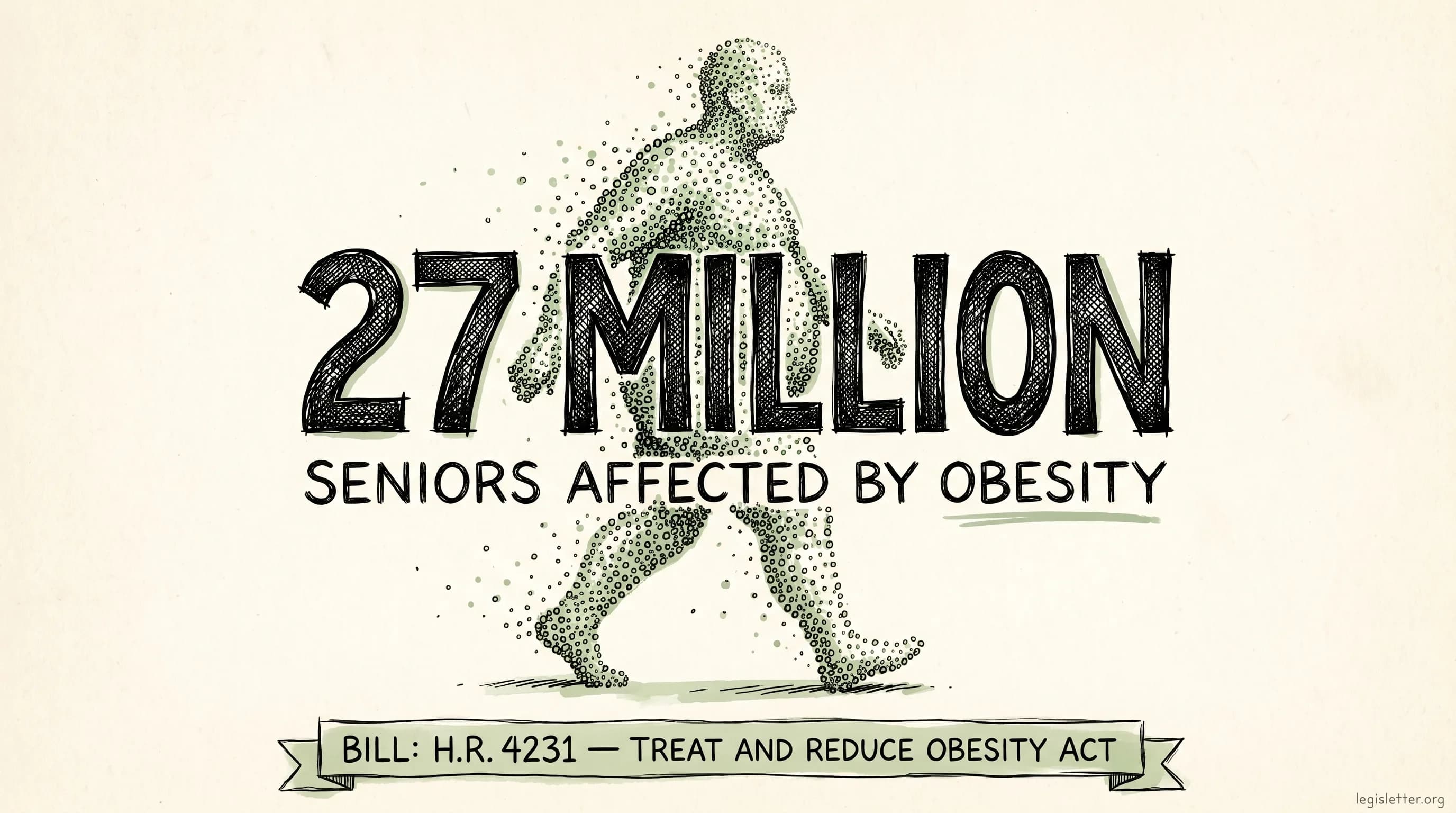
Medicare currently covers a narrow version of obesity counseling — only from your primary care doctor, in a clinical setting. That leaves out the dietitians, psychologists, and nurse practitioners who specialize in long-term weight management.
H.R. 4231 expands that list. Under the bill, HHS could approve coverage for obesity therapy provided by physician assistants, nurse practitioners, clinical psychologists, and registered dietitians. It also opens the door to community-based weight management programs — think structured group counseling that meets federal privacy standards.
The bigger change is on the drug side. Right now, Medicare Part D specifically excludes drugs used for weight loss — including GLP-1 medications like Ozempic and Wegovy that have transformed obesity treatment. The bill lifts that exclusion for obesity treatment and for overweight people with related conditions like diabetes or heart disease. That change kicks in two years after enactment.
The bill's findings lay out why Congress thinks the math works: $50 billion in Medicare spending tied to obesity in 2014, roughly $2,018 in extra annual costs per beneficiary with obesity, and a trajectory that puts nearly half of Medicare beneficiaries over 65 in the obesity category by 2030 if nothing changes.
Bill Progress
Latest Action · Jun 27, 2025
Referred to Energy and Commerce, and in addition to the Committee on Ways and Means, for a period to be subsequently determined by the Speaker, in each case for consideration of such provisions as fall within the jurisdiction of the committee concerned. for review
H.R. 4231 Bill Summary
What H.R. 4231 actually does.
Dietitians and psychologists can finally bill Medicare for obesity care
Medicare currently limits obesity counseling to primary care doctors. The bill adds physician assistants, nurse practitioners, clinical psychologists, and registered dietitians to the covered provider list.
Community weight-loss programs enter the Medicare system
HHS can approve evidence-based community lifestyle counseling programs to provide covered obesity therapy — as long as they meet federal privacy rules and coordinate with your doctor.
Your doctor stays in charge of referrals
Every specialist visit or community program requires a referral from your physician or primary care practitioner. Providers have to send treatment plans back to that doctor.
Medicare drug plans cover obesity medications for the first time
Part D's current exclusion on weight-loss drugs gets lifted for obesity treatment and for overweight people with related conditions like diabetes or heart disease. Coverage starts two years after enactment.
Congress gets regular progress reports from HHS
HHS must deliver an initial implementation report within one year, then follow-up reports every two years — including recommendations for better coordination across federal obesity research and care programs.
Who benefits from H.R. 4231?
Medicare patients managing obesity
The bill's findings cite 27 million adults over 60 with obesity. If you're on Medicare and your doctor has recommended drug treatment or specialist counseling, this bill is the difference between paying out of pocket and having it covered.
Dietitians, psychologists, and nurse practitioners
These providers already treat obesity — they just can't bill Medicare for it. The bill adds them to the covered provider list, opening a new revenue stream and likely increasing patient access.
GLP-1 drugmakers
Manufacturers of obesity drugs gain access to the Medicare Part D market — one of the largest prescription drug payers in the country.
Who is affected by H.R. 4231?
Medicare Part D plans
Must add obesity drug coverage within two years. That means new formulary decisions, pricing negotiations, and utilization management for a drug class that already costs $1,000+ per month retail.
Primary care doctors
Referral and coordination requirements mean more paperwork but also more control. Every specialist or community program has to loop the PCP back in.
CMS and HHS
Must build quality measures, approve community programs, and deliver implementation reports to Congress starting one year after enactment.
HR4231 Legislative Journey
House: Committee Action
Jun 27, 2025
Referred to the Committee on Energy and Commerce, and in addition to the Committee on Ways and Means, for a period to be subsequently determined by the Speaker, in each case for consideration of such provisions as fall within the jurisdiction of the committee concerned.
About the Sponsor
Mike Kelly
Republican, Pennsylvania's 16th congressional district · 15 years in Congress
Committees: Ways and Means
View full profile →
Cosponsors (85)
This bill has 85 cosponsors: 65 Democrats, 20 Republicans, reflecting bipartisan support. Cosponsors represent 35 states: Alabama, Arizona, California, and 32 more.

Raul Ruiz
Democrat · CA

Mariannette Miller-Meeks
Republican · IA

Gwen Moore
Democrat · WI
Jimmy Panetta
Democrat · CA
Brian Fitzpatrick
Republican · PA

Brendan Boyle
Democrat · PA

Mike Carey
Republican · OH

Shri Thanedar
Democrat · MI

Steve Cohen
Democrat · TN

Eleanor Norton
Democrat · DC

Rashida Tlaib
Democrat · MI

David Schweikert
Republican · AZ
Committee Sponsors
Ways and Means Committee
15 of 45 committee members cosponsored


Energy and Commerce Committee
11 of 54 committee members cosponsored


46 Republicans across these committees haven't cosponsored yet. Mobilize their constituents
What laws does H.R. 4231 change?
1 changes
Sections Amended
Section 1861(ddd) of Social Security Act (42 U.S.C. 1395x(ddd))
adding at the end the following new paragraph: ``(4)(A) Subject to subparagraph (B), the Secretary may, in addition to qualified primary care physicians and other primary care practitioners, cover intensive behavioral therapy for obesity furnished by any of the following: ``(i) A physician (as defined in subsection (r)(1)) who is not a qualified primary care physician
H.R. 4231 Quick Facts
- Committee
- Ways and Means
- Chamber
- House
- Policy
- Health
- Introduced
- Jun 27, 2025
Referred to Energy and Commerce, and in addition to the Committee on Ways and Means, for a period to be subsequently determined by the Speaker, in each case for consideration of such provisions as fall within the jurisdiction of the committee concerned. for review
Jun 27, 2025
Official Sources
Official bill page with text, cosponsors, committees, and legislative status for the Treat and Reduce Obesity Act of 2025.
Official NIH/NIDDK overview of obesity and overweight, relevant to the bill's findings on health risks and treatment.
Primary CMS manual source for Medicare coverage policy and provider rules relevant to counseling and referral requirements.
Official codified text of Medicare's statutory authority, which this bill would amend under title XVIII of the Social Security Act.
Official Congressional Budget Office page to check whether a cost estimate for H.R. 4231 has been published.
H.R. 4231 Common Questions
Will Medicare cover Ozempic under H.R. 4231?
The bill doesn't name specific drugs, but it lifts Medicare Part D's exclusion on obesity medications. GLP-1 drugs like Ozempic and Wegovy would become eligible for coverage if prescribed for obesity or weight loss with related conditions.
When would the drug coverage start?
Two years after the bill becomes law. Part D plans need time to update formularies and negotiate pricing.
Can I see a dietitian through Medicare for weight loss?
Not under current rules — Medicare only covers obesity counseling from your primary care doctor. H.R. 4231 adds dietitians, psychologists, nurse practitioners, and physician assistants to the covered provider list.
How much does obesity cost Medicare?
The bill's findings cite $50 billion in 2014 and about $2,018 more per year for each beneficiary with obesity. The obesity rate among Medicare beneficiaries nearly quadrupled from 1987 to 2016.
Do I still need a doctor's referral?
Yes. If you see a specialist or join a community program for obesity counseling, it has to be through a referral from your primary care doctor, and the provider has to send your treatment plan back to that doctor.
Does the bill create new funding?
No. It expands what Medicare can pay for but doesn't appropriate new money. The cost depends on how many people use the new coverage — and no CBO score has been published yet.
What community programs could qualify?
HHS can approve evidence-based community lifestyle counseling programs. They need to meet federal privacy rules and coordinate with your doctor. Think structured group programs, not gym memberships.
Based on H.R. 4231 bill text
H.R. 4231 Bill Text
“To amend title XVIII of the Social Security Act to provide for the coordination of programs to prevent and treat obesity, and for other purposes.”
Source: U.S. Government Publishing Office
Get notified when H.R. 4231 moves
Committee votes, floor action, cosponsor changes — straight to your inbox.
Bill alerts + Legisletter's monthly briefing. Unsubscribe anytime.
Health Bills
9 related bills we're tracking
Nancy Gardner Sewell Medicare Multi-Cancer Early Detection Screening Coverage Act



Reported (Amended) by the Committee on Ways and Means. H. Rept. 119-333, Part I.
Oct 3, 2025
Mikaela Naylon Give Kids a Chance Act




Received in the Senate.
Dec 2, 2025
Improving Seniors’ Timely Access to Care Act of 2025



Ordered to be Reported in the Nature of a Substitute by the Yeas and Nays: 42 - 0.
Jul 15, 2026
CONNECT for Health Act of 2025



Referred to the Committee on Energy and Commerce, and in addition to the Committee on Ways and Means, for a period to be subsequently determined by the Speaker, in each case for consideration of such provisions as fall within the jurisdiction of the committee concerned.
Jun 26, 2025
ASAP Act




Ordered to be Reported in the Nature of a Substitute by the Yeas and Nays: 40 - 0.
Sep 16, 2026
Momnibus Act



Referred to the Subcommittee on Health.
Apr 20, 2026
Ensuring Lasting Smiles Act



Referred to the Committee on Energy and Commerce, and in addition to the Committees on Education and Workforce, and Ways and Means, for a period to be subsequently determined by the Speaker, in each case for consideration of such provisions as fall within the jurisdiction of the committee concerned.
May 8, 2025
Right to Contraception Act




Referred to the House Committee on Energy and Commerce.
Feb 5, 2025
Women’s Health Protection Act of 2025



Referred to the Committee on Energy and Commerce, and in addition to the Committee on the Judiciary, for a period to be subsequently determined by the Speaker, in each case for consideration of such provisions as fall within the jurisdiction of the committee concerned.
Jun 24, 2025
Trending Right Now
Bills gaining momentum across Congress
Fit to Serve Act




Referred to the House Committee on Armed Services.
May 21, 2025
America’s Olympic and Paralympic Games Commemorative Coins Act





Referred to the House Committee on Financial Services.
Jul 14, 2025
Therapeutic Fraud Prevention Act of 2025




Referred to the House Committee on Energy and Commerce.
May 7, 2025
Tracking Health in Congress? Monitor bills, track cosponsor momentum, and launch advocacy campaigns — all from one advocacy platform.