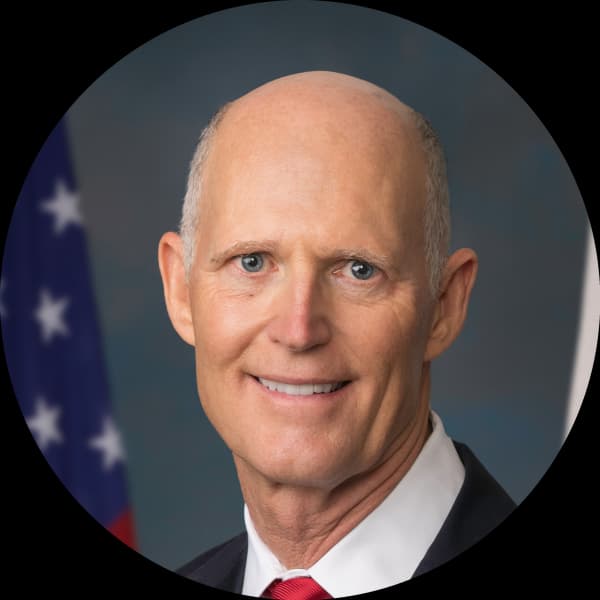
Rick Scott
State of Florida
Florida Senate Intelligence
Rick Scott represents a sprawling, expensive, older Florida that still votes reliably Republican, but with enough demographic and economic crosscurrents to keep statewide politics live. The state’s R+15 lean gives him structural room, yet a 27.4% Hispanic population and a notably old electorate—21.3% over 65—make his coalition less ideologically uniform than it looks. His committee footprint on Armed Services, Foreign Relations, Budget, and Aging fits the state’s mix of retirees, veterans, and national-security-minded transplants, while his brand remains rooted in fiscal conservatism and executive-style governance.
For advocates, this is a persuasion environment built around cost, security, and competence—not ideology. Florida’s 11.5% uninsured rate and $1,669 median rent create real pressure around affordability, but messages land best when tied to protecting seniors, lowering household costs, or strengthening resilience rather than expanding government. Campaigns should segment aggressively: retirees and veterans respond to stability and fraud prevention; Hispanic audiences are movable on economic mobility and public safety. The strategic opening is to frame asks as practical, fiscally disciplined fixes with clear statewide payoff.
Economic & Demographic Snapshot
Data sourced from U.S. Census Bureau ACS 5-Year Estimates (2017-2021 vs. 2019-2023). All figures are statistical estimates with 90% confidence level.
Florida State Demographics
Median Age 42.6 (vs 38.5) · Homeownership 67.6% (vs 65.5%) · Bachelor’s+ 34.2% (vs 33.7%) · Poverty 8.9% (vs 12.4%) · Income $74,568 (vs $37,585)
Age Distribution
Skews older than the national average (median age 42.6 vs 38.5 nationally). 15% of residents are 70+. Medicare, Social Security, and healthcare access are top-of-mind.
Race & Ethnicity
White residents are the largest group at 55.9%. Also significant: Hispanic (27.4%), Black (15.1%).
* Hispanic includes respondents of any race. Racial categories include both Hispanic and non-Hispanic individuals.
Education
34.2% hold a bachelor’s degree or higher, above the 33.7% national average. 10% of residents lack a high school diploma.
Income Distribution
Median household income is $74,568, well above the $37,585 national median.
Housing
Homeownership at 67.6% (vs 65.5% nationally). Median rent is $1,669. Median home value is $359,000.
How People Get to Work
Car-dependent: 70.2% drive alone to work. Average commute is 28 minutes.
Florida Senate FAQ
Reach Florida Lawmakers
This seat is competitive. Senator Scott focuses on International Affairs, Finance and Financial Sector and Government Operations and Politics. Deliver personalized constituent letters to Florida's federal, state, and local officials — live in under five minutes.
Grassroots advocacy & legislator intelligence. Used by nonprofits, associations, and GR firms nationwide.
Start a Campaign