
When I started building Legisletter, I had a question: what if AI actually read the bill before anyone wrote a word about it?
Not summarized it. Not skimmed the title. Read the full text — provisions, funding thresholds, compliance timelines, population definitions — and used that to figure out which districts are most affected, which people should be weighing in, and what each of them should say based on their own situation.
That's what I built. Here's how each layer works.
AI Reads the Bill
When you build a campaign on Legisletter — whether it's targeting a bill in Congress or a proposed regulation on regulations.gov — the AI starts by reading the primary source. Not a summary. Not your campaign description. The full text.
For a bill, that means parsing the legislative language, identifying key provisions, and understanding which populations are referenced. For a regulation, it reads the full proposed rule — the same document posted on regulations.gov that attorneys and lobbyists spend hours picking apart.
This matters because the source material contains specifics that summaries flatten. Section numbers. Funding thresholds. Compliance timelines. Population definitions. The AI uses these to ground everything downstream — from audience identification to comment drafting — in what the legislation actually says, not what someone thinks it says.
AI Maps District-Level Impact
Legisletter maintains 42 demographic metrics across all 435 congressional districts and 50 states — covering economics, health, housing, education, industry, race and ethnicity, digital access, and election data.
When you select a bill, the AI analyzes it and determines which metrics are most relevant. A health bill might weight uninsured rate, disability prevalence, and poverty. A housing bill like the Affordable Housing Credit Improvement Act might weight rent burden, homeownership rate, and median rent. An agriculture bill might weight rural population and self-employment rate.
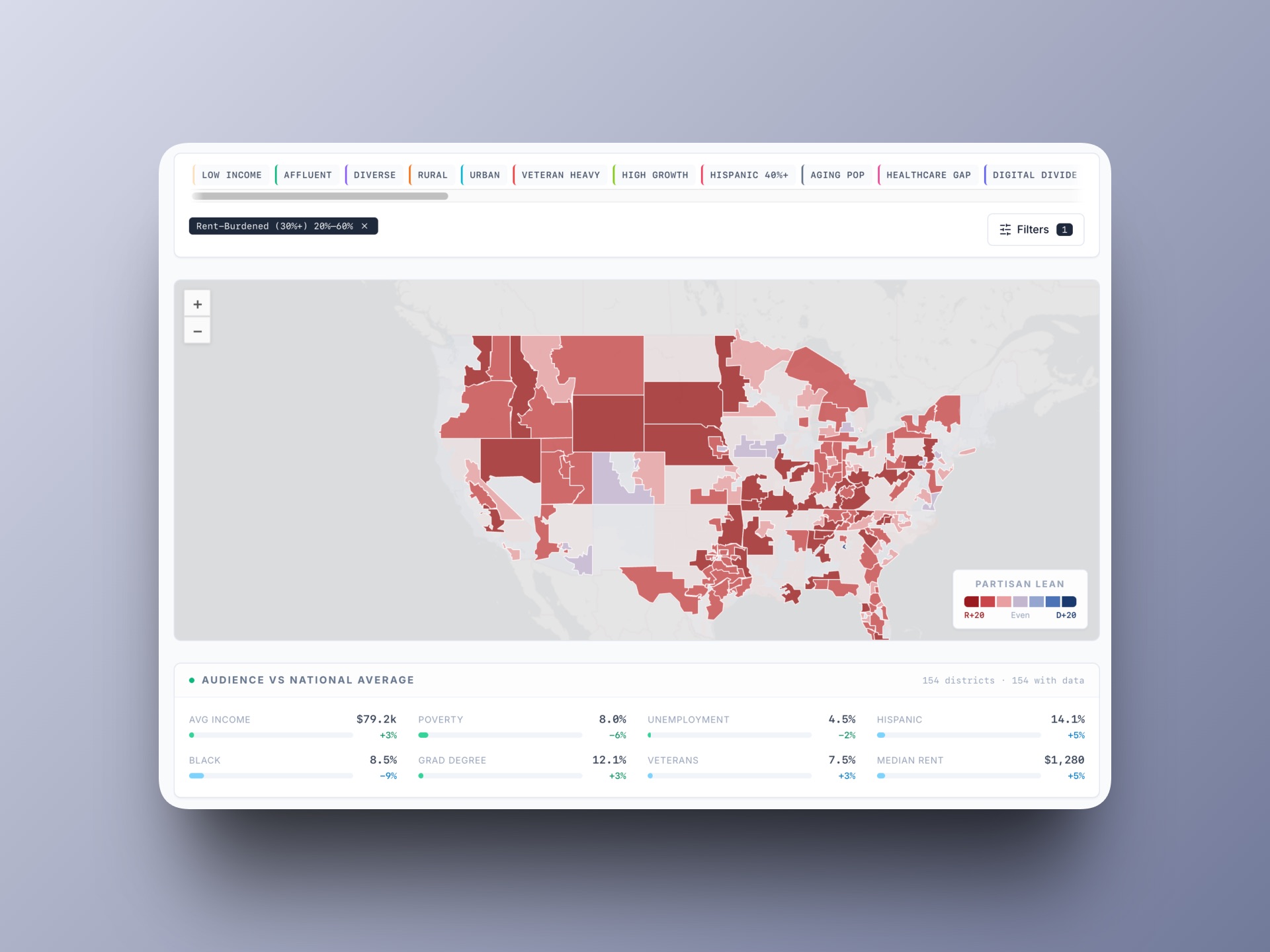
Target legislator districts based on rent burden, uninsured rates, or any of 42 demographic metrics — then export directly to paid media.
The result is a heatmap across all 435 House districts showing where a bill would land hardest. Districts scoring 80+ on a 0-100 impact scale light up in deep amber. Districts with minimal exposure fade to light yellow. You're looking at a map of where this bill actually matters — not where your mailing list happens to live.
And you can search it in plain English. Type "swing district Republicans with high uninsured rates" and the system translates that into structured demographic filters — party, vote margin, insurance coverage — and returns a filtered list of legislators with their district data.
AI Identifies Real Constituents
For regulatory campaigns, the AI reads the proposed rule and identifies up to five distinct audience segments — real types of people who would naturally submit a public comment.
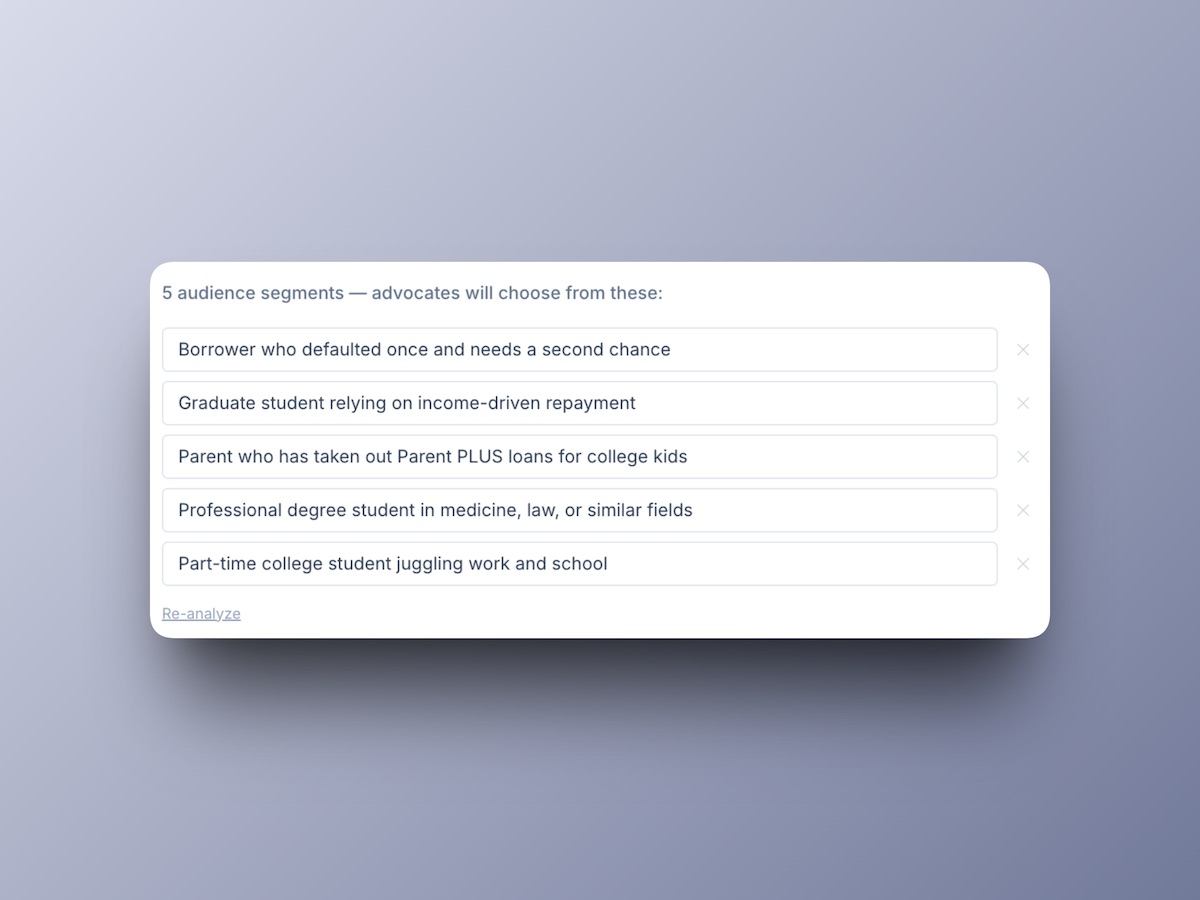
AI reads a proposed student loan regulation and identifies five real audience segments — borrowers, graduate students, parents, professional students, and part-time workers — each with specific provisions that affect them.
These aren't marketing personas. The system is explicitly designed to reject institutional labels like "Healthcare Industry Stakeholders" in favor of human-first descriptions: "Parent of a child with food allergies." "Independent truck driver within 50 miles of a distribution hub." "Small dairy farmer operating under 200 head."
Each segment comes with:
- Specific provisions from the regulation that affect them (traceable section references, not vague policy language)
- A concrete pain point — what changes for this person if the rule passes
- An ad hook — a 10-15 word headline that captures attention
- A campaign angle — how to frame outreach to this audience
The AI reads the regulation text itself to discover these audiences — it doesn't just trust the campaign description. This means it surfaces segments the organization hadn't considered, drawn directly from what the rule actually proposes to change.
Every Letter Knows Its Legislator
This is where most advocacy platforms fall apart. They generate a single template, swap in a name, and call it "personalized." Agencies that receive 500 identical comments count them as one submission. Legislative offices that see the same paragraph from 200 constituents know it's a form letter.
According to the Congressional Management Foundation, only 3% of congressional staffers say form letters have "a lot of influence" on an undecided member. But here's the flip side: fewer than 50 personalized messages can move an undecided Member in 70% of offices. The difference isn't volume — it's whether the letter gets batched into a tally or routed individually to the Legislative Assistant who covers that issue.
Legisletter's letter drafting works differently — on both the regulatory and legislative sides.
For regulatory comments, every submission is structurally unique — different length, different angle, different provisions cited. Nothing is fabricated. The AI won't invent a persona, a salary figure, or an anecdote. If the advocate shares their background, the comment reflects it. If they don't, it advocates for affected populations plainly without pretending to be someone it's not.
For legislative letters, the AI knows who it's writing to — and what the advocate cares about. Advocates select the topics that matter most to them, integrate key facts from the campaign's fact sheet, and the letter is shaped around those choices. If the legislator is already a cosponsor, the letter opens with thanks and asks them to champion the bill publicly. If they sponsored it, the letter leads with gratitude for introducing it and pushes for floor votes. If they haven't cosponsored, the letter makes the case for why they should. The tone shifts by party, by chamber, and by the legislator's policy focus — a letter to a Senate Republican on the Armed Services Committee reads nothing like a letter to a House Democrat on Education and Workforce.
Co-written, not generated. The AI gives advocates a starting point grounded in the actual legislation — specific provisions, real impact. The advocate brings their own voice, their own story, their own edits. The result is a comment or letter that's genuinely theirs, not something a system produced on their behalf.
For legislative campaigns, the same principles apply. Each letter is co-written with the advocate, addressed to their specific legislator, and shaped by what the advocate actually cares about. The AI handles the policy detail so the advocate can focus on why it matters to them.
From Intelligence to Action to Paid Media
Here's where the layers connect.
You've used the AI to identify which districts are most impacted by a bill. You've filtered to the legislators who aren't yet cosponsors. You've built a targeting list based on demographic impact scores, party, and committee assignments.
That same filtered list exports directly to paid media platforms. One click copies district-level geo-targeting data formatted for Meta Ads. Another exports in Google Ads format. A full CSV download includes every legislator with their demographic data, population stats, and cosponsor status.
The loop closes: AI reads the bill, maps where it matters, identifies who's affected, drafts personalized action — and the same intelligence that powers your grassroots campaign powers your ad targeting. You're not running two separate workflows. The paid media brief writes itself from the same data that powered the advocacy campaign.
One Campaign, Three Fronts
A single Legisletter campaign can simultaneously:
- Target legislators with personalized constituent letters, matched by address to the right representative and senator
- Flood a regulatory docket with unique, substantive public comments that agencies weigh individually
- Reach additional decision-makers — agency staff, committee chairs, coalition partners — with per-recipient letter templates
Plus export the targeting intelligence to run paid media against the same districts.
All from the same campaign, using the same underlying intelligence.
See the AI in action. Book a demo and we'll walk through a live campaign — from bill analysis to district heatmap to personalized letters — using legislation that matters to your organization.
Built for Government Relations
Give your clients measurable grassroots impact at a fraction of the cost of legacy platforms.