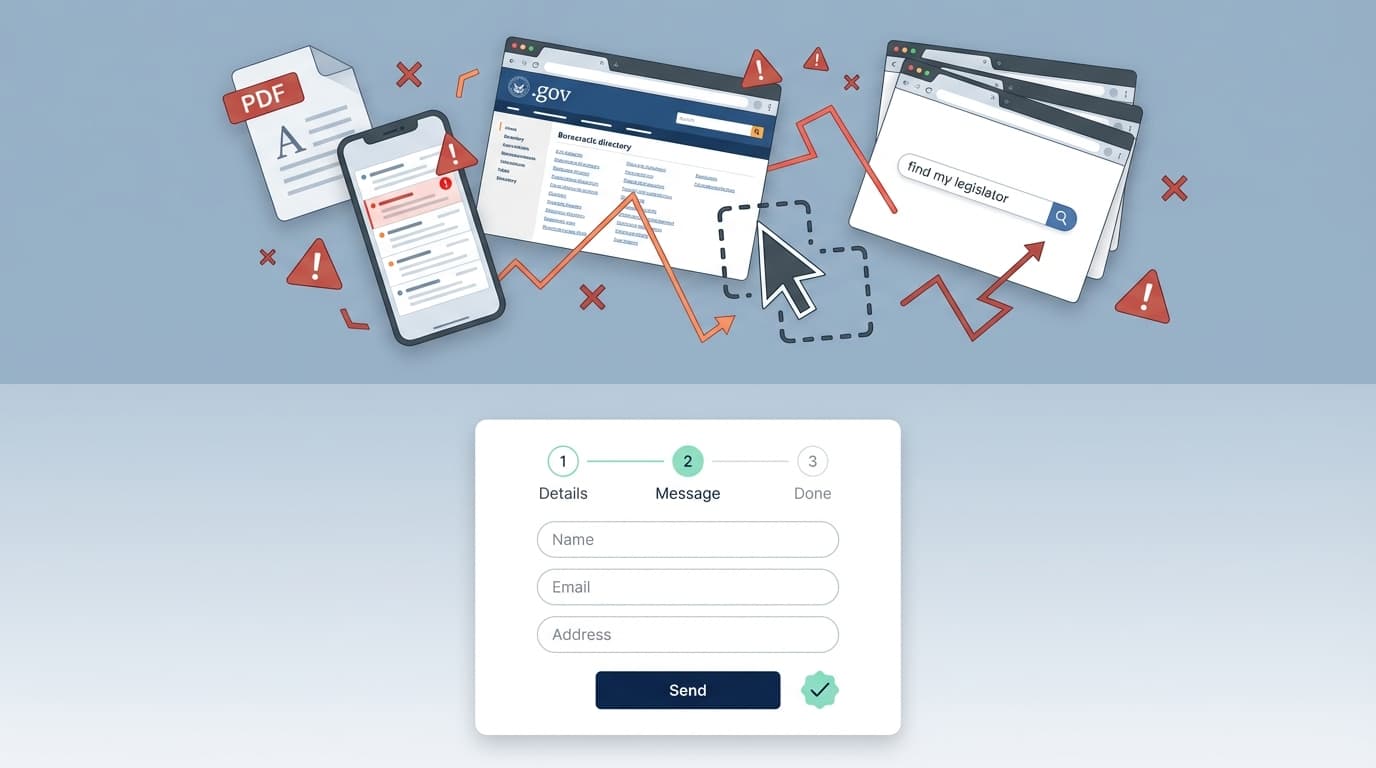
We keep hearing the same thing from association government affairs teams: they draft a letter, export it as a PDF, email it to members with a link to look up their legislator, and ask everyone to copy-paste the text into a contact form. They already know it's too many steps. They just don't have a better option.
The Five-Step Wall
Here's what you're actually asking members to do when you send a PDF action alert:
- Open the email and read the context
- Download and open the PDF on whatever device they're using
- Look up their legislator using the link you provided (which means entering their address on a separate site, finding the right name, and probably navigating a confusing .gov directory)
- Find the legislator's contact form or email — another search, another site
- Copy-paste the letter, personalize the salutation, add their info, and hit send
Each step is a decision point where someone can — and will — drop off. Research on conversion funnels shows that each additional step loses 30–80% of participants. If you start with 1,000 members opening that email, you might get 400 to open the PDF. Maybe 150 look up their legislator. Perhaps 50 make it to the contact form. And 15–30 actually send a letter.
Your members care. Your workflow is losing them.
The math of friction: 1,000 members × 5 steps × 50% drop-off per step = 31 letters sent. 1,000 members × 1 step × 60% completion = 600 letters sent. Same members. Same issue. Same passion. Different tooling.
Why Good Members Don't Follow Through
It's tempting to interpret low participation as low interest. "Our members just aren't that engaged." But think about what you're asking.
Your member is a working professional. They opened your email on their phone between meetings. They care about the bill — that's why they opened it. But you're asking them to download a PDF on mobile (already annoying), navigate to a separate website, enter their address, figure out which legislator is theirs, find a contact form, copy text from a PDF into a web form, edit the salutation, and add their personal information.
That's 10 minutes of focused work across multiple apps and browser tabs. On a phone. Between meetings.
The member who doesn't do this isn't disengaged. They're busy. And you just handed them a homework assignment instead of a button.
What "Easy" Actually Looks Like
Most grassroots advocacy platforms still measure success in single-digit response rates. That's not a ceiling — it's what happens when every tool in the space still treats "easy" as "slightly fewer form fields."
When you actually remove friction from the process, the numbers change fast. Across Legisletter campaigns, we see a 58% advocate conversion rate and an 86% community opt-in rate across hundreds of campaigns. When you take a 5-step PDF workflow and turn it into one page, people actually do it.
Here's what the workflow looks like for your member:
- Click the link in your email
- Enter their address
- Edit a pre-written letter already addressed to their legislator
- Hit send
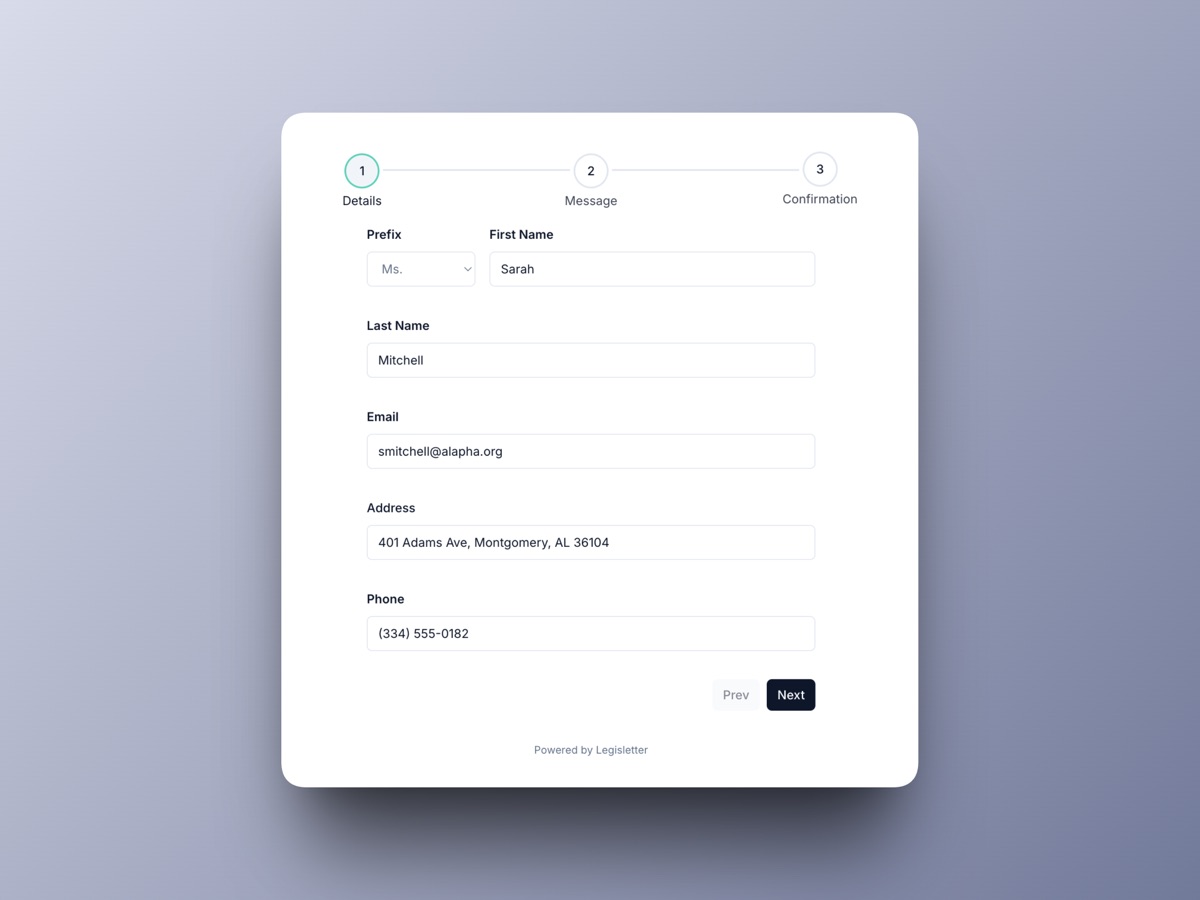
One link. Address in, personalized letters sent, call scripts ready, and a share link for colleagues — under 60 seconds.
One page. Two minutes. No PDFs, no legislator lookup, no copy-paste, no hunting for contact forms. The system handles legislator matching, letter co-writing, and delivery.
The difference between single-digit response rates and 58% isn't member motivation — it's the number of steps between "I care about this" and "done."
The Hidden Cost of Low Participation
Low response rates don't just mean fewer letters. They create a compounding problem for your association:
Your advocacy loses credibility. When a legislator's office receives 15 letters from an association that claims 5,000 members, that's a signal — just not the one you want to send. Volume matters in legislative advocacy. A few dozen letters from a large membership base tells the office your members don't actually care enough to act.
Your members disengage from more than advocacy. When someone tries to complete your action alert and gives up halfway through the legislator lookup, they don't just skip the letter. They feel a small pang of failure or frustration associated with your organization. Do that enough times and they stop opening your emails entirely.
Your government affairs team burns out. They spent hours crafting the perfect letter, building the PDF, writing the email, and the result is 20 letters from 3,000 members. That's demoralizing. Over time, the team stops running action alerts because "our members don't respond," when the real issue was never the members.
What Changes When You Fix the Tooling
Associations that switch from PDF-based workflows to purpose-built advocacy platforms consistently see participation rates climb from single digits to 20–40%. But the numbers aren't the most interesting part. Here's what else changes:
Members personalize their letters. When the default letter is pre-filled but editable, a surprising number of people add their own story. A nurse adds a paragraph about what she sees in her ER. A small business owner explains how the regulation affects his supply chain. These personal additions are what legislative staff actually read and remember.
You can run more campaigns. When launching an action alert takes 15 minutes instead of half a day of PDF formatting and instruction-writing, your team can respond to legislative developments in real time. Bill gets scheduled for markup on Tuesday? Your members can have letters delivered by Wednesday morning.
You build a participation habit. The first action is the hardest. Once a member has sent one letter and seen how easy it was, the second one takes 30 seconds. They already have their address saved. They already trust the process. By the third campaign, you have a core of reliable advocates who act every time you ask.
Start With Your Next Action Alert
You don't need to overhaul your entire advocacy program. Just run your next campaign as a single link instead of a PDF attachment. Members click, enter their address, edit a pre-written letter that's already addressed to their legislators, and send. Then compare the numbers to your last PDF blast.
Your members care about the issues. Give them a tool that respects their time. Legisletter handles legislator matching, AI-assisted letter co-writing, and direct delivery — so your next action alert is a link, not a homework assignment. See how it works.
Built for Association Advocacy
Turn your next action alert into a single link. Members click, write, and send — no PDFs, no copy-paste.